Four places, four rulebooks: the limits, the units they count in, and what's not on the list

The four limits are not one number. Hong Kong protects up to HK$800,000; the UK protects £120,000 per eligible depositor, per bank or building society; the US insures US$250,000 per depositor, per insured bank, per account ownership category; Singapore covers up to S$100,000 per depositor, in aggregate, at each Scheme member bank. The numbers are easy to remember. The hard part is the second half of each sentence — the four places do not count in the same unit, and if you copy the wrong unit the answer comes out a long way off.
Two places trip people up most. One is foreign currency: Hong Kong’s list of protected deposits says in so many words “deposits in Hong Kong dollars, renminbi or other currencies”, while Singapore’s deposit insurance scheme expressly does not cover foreign-currency deposits. The other is the balance showing in an app, which is usually not a bank deposit at all and falls under a separate arrangement called safeguarding. Each gets its own section below.
Before you start: the amounts and rules in this piece were checked in September 2026, and official pages in all four places can change at any time; for what applies to your own account, go by what your institution and your local protection scheme say at the time. And there is a more important layer on top of that: deposit protection describes the payout ceiling when a member institution fails. It is not a promise that your money is safe, and it does not cover money taken by card fraud or talked out of you by a scam. This piece only maps where the rules stop. It doesn’t rank banks, and it gives no advice on allocating or managing money.
01The four limits, and the unit each one counts in
Start by putting the key sentence from each of the four official pages side by side. The numbers are what people memorise; the third column is what you actually use when you do the arithmetic.
| Place | Maximum payout | The unit it's counted in |
|---|---|---|
| Hong Kong | HK$800,000 | Paid out automatically, when a member bank fails, to depositors who hold eligible deposits with that bank |
| UK | £120,000 | Per eligible depositor, per bank / building society / credit union; brands sharing one licence count as a single institution |
| US | US$250,000 | Per depositor × per insured bank × per account ownership category |
| Singapore | S$100,000 | Per depositor, for insured deposits held in aggregate at each Scheme member bank |
Hong Kong. What the Hong Kong Deposit Protection Board page says is this: when a member bank fails, the Scheme automatically pays compensation of up to HK$800,000 to depositors holding eligible deposits. The same page carries another line: after two member banks merge or one is acquired, the protected deposits formerly held with each bank still enjoy separate protection of up to HK$800,000 for a limited period. That the limit follows the bank is something I read out of this clause; the page does not have a separate sentence spelling out "per bank".
UK. The FSCS wording is up to £120,000 per eligible depositor, per bank, building society or credit union, applying to firms that fail after 30 November 2025; the limit was raised to £120,000 on 1 December 2025. The firm has to be authorised by the PRA. Easier to get wrong than the limit itself is the next clause: several brands inside one group that share a single banking licence have to be counted as one institution, and the £120,000 applies to your total across those accounts. If you want two sums of money to each have their own limit, you have to pick institutions that don't share a licence—and you can look the licence up yourself on the FCA's Financial Services Register.
On joint accounts, the wrong statement I see most often is "a joint account is covered for £240,000". What the FSCS page says is that joint accounts are protected by the FSCS as well, with the same limit of £120,000 per eligible depositor—the limit follows the person, and a joint account counts towards each holder's own limit according to their share. On top of that, within the same group, your sole account and the part of a joint account that belongs to you are added together. Hong Kong has a similar note: holders of a joint account are treated as each having an equal share of the deposit in question.
US. The FDIC's standard insurance amount is US$250,000 per depositor, per insured bank, per account ownership category—all three qualifiers have to hold at once. At the same bank and within the same ownership category, checking accounts, NOW accounts, savings accounts, money market deposit accounts and certificates of deposit are added together; different ownership categories are insured separately; different banks apply separately as well. The top of that page also carries a trust rule effective 1 April 2024: where there are five or more beneficiaries, all trust accounts of the same owner at the same bank are capped at US$1,250,000 in total.
Singapore. The SDIC FAQ says this: Singapore dollar deposits in savings accounts, fixed deposit accounts and current accounts, plus money placed under the Supplementary Retirement Scheme (SRS), are insured up to S$100,000 in aggregate per depositor at each Scheme member bank. Deposits under the CPF Investment Scheme and the CPF Retirement Sum Scheme are aggregated separately for another S$100,000. Trust accounts and client accounts are counted per account and are not combined with your own other accounts. Joint accounts are split in equal shares (unless the member bank's records show otherwise) and then combined with your other accounts at that same bank—the official example is a couple's joint account of S$90,000 plus a separate personal account of S$60,000: the deposits counted against that one person come to S$105,000 (half the joint account, S$45,000, plus the S$60,000), and in SDIC's words that total “will be covered up to the maximum of S$100,000”. The S$5,000 above the cap is not insured.
The first time I read those four pages together, I copied the four "units" onto one sheet of paper: Hong Kong is person + bank, the UK is person + licence, the US is person + bank + ownership category, Singapore is person + member bank + currency. Only once it was written down did I see where I'd been going wrong: the UK column says "licence", not "brand", and the US column has one extra item, "category", that the others don't. As for how many accounts to open and how much to put in each, that's your own arrangement, and this piece doesn't advise on it.
02Foreign currency: on Hong Kong's list, expressly excluded in Singapore
This is the cleanest split between the four places, and there's official wording on both sides to check it against.
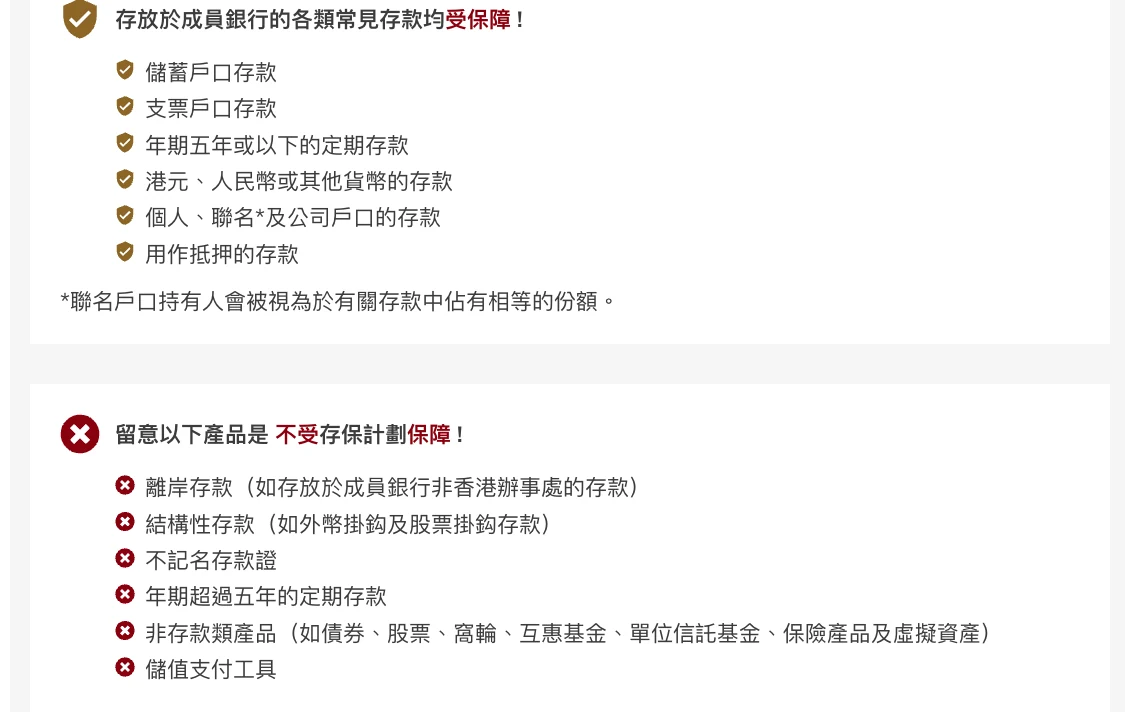
Hong Kong covers it. The Deposit Protection Board's list of protected deposits runs item by item: savings account deposits, current account deposits, time deposits with a maturity of five years or less, deposits in Hong Kong dollars, renminbi or other currencies, deposits in personal / joint / company accounts, and deposits pledged as security. In other words, US dollar, euro and yen deposits opened at a member bank are eligible deposits in the same way Hong Kong dollar deposits are, and they go into the same HK$800,000 ceiling. As for which point in time and which exchange rate a foreign currency balance would be converted at, that page doesn't say, so this piece won't guess.
Singapore doesn't. One question in the SDIC FAQ is exactly this, and the answer is blunt: the Deposit Insurance Scheme does not cover foreign currency deposits, structured deposits, or investment products such as unit trusts, shares and other securities. The same FAQ gives the reason—foreign currency deposits and structured deposits sit closer to investment products, where the investor takes on higher risk for a potentially higher return, and they aren't the core savings of a small depositor.
What that means in practice: US dollars sitting in a Singapore member bank don't enter the S$100,000 calculation, whichever bank it is; US dollars sitting in a Hong Kong member bank count towards the HK$800,000. Miss this layer and it's easy to read "I opened an account at a protected bank" as "this money of mine is protected"—there's a currency list sitting between those two sentences.
How the UK and the US treat foreign currency is something I didn't establish this time round: I only checked the limit pages and the product list pages, and neither had explicit wording on foreign currency, so this section covers Hong Kong and Singapore only.
03What simply isn't on the list
More worth a look than the limit is the "not protected" column. If the money isn't on the list, it doesn't matter how high the limit is. Hong Kong's non-protected list runs like this, item by item:
- Offshore deposits, meaning deposits held with offices of a member bank outside Hong Kong. Same bank name, different place of deposit, different outcome.
- Structured deposits, such as foreign-exchange-linked and equity-linked deposits. The word "deposit" is in the name, but they aren't handled under deposit protection.
- Bearer certificates of deposit.
- Time deposits with a maturity longer than five years. Five years is the dividing line; the ones with five years or less are on the protected list.
- Non-deposit products: bonds, stocks, warrants, mutual funds, unit trusts, insurance products, and virtual assets.
- Stored value facilities. The balance in an e-wallet is not a bank deposit, and this item and the next section are about the same thing.
The US exclusion list reads a little differently but points the same way: stocks, bonds, mutual funds, crypto assets, life insurance policies, annuities and municipal securities are not covered by FDIC insurance, and neither are safe deposit boxes or their contents. US Treasury securities are the odd one out—not insured by the FDIC, but backed by the full faith and credit of the United States government.
That FDIC page also carries a line that is rarely quoted and matters a great deal: deposit insurance does not cover losses due to theft or fraud. Deposit protection in all four places is aimed at the same single situation—a member institution failing. A card used fraudulently, or money you were talked into transferring, goes down a different road: the card issuer's dispute process and the reporting channels where you live. That has nothing to do with deposit protection.
One more situation that often gets mixed in: the bank hasn't failed, but it has unilaterally ended its account relationship with you. That isn't deposit protection's business. You can usually move the balance out by the method the bank gives you, and what you have to worry about is timing and the route out, which is written up in what to do when an overseas account is closed. Reporting obligations for accounts held abroad follow yet another logic; the basic framework is in overseas accounts and tax: the basics a beginner needs, and for anything touching your own situation, consult a qualified tax adviser.
04Money in an app isn't a bank deposit
The conclusion first: whether a sum of money is covered by deposit protection isn't decided by the number on the app screen, but by where that money ultimately sits and whether that institution is a protected deposit-taking institution.
E-money institutions and banks run on two different arrangements. The first is called safeguarding: customer money has to be held separately from the institution's own funds. It isn't deposit protection, and both what triggers it and how payouts work are a different matter.
Revolut's help page sets out this migration fairly clearly, and it reads well as one concrete example: after an account moves to Revolut Bank, the funds are held at Revolut Bank and protected by the FSCS, with eligible deposits covered up to £120,000. The balances the page lists as counting towards that include current accounts (including non-GBP sub-accounts), Kids & Teens (main parent), Pocket balances, Group Pocket (the creator), Revolut Pro, and joint accounts—joint account balances are split 50/50, each up to £120,000. And before the migration? The same page says funds in the e-money account were safeguarded at that point; once the account moves to Revolut Bank, safeguarding no longer applies.
The same page draws another line: products not on that list—crypto assets, commodities, stocks—are provided by different entities and fall outside Revolut Bank UK Ltd's FSCS protection. Protection follows the legal form called a "deposit"; it doesn't follow the icon in an app.
Which state your own account is in right now isn't something this page answers—it gives no migration schedule or batch—so you have to look at the terms page in the app and the help centre's current wording. The opening process for these two is written up in Monzo vs Revolut: opening a UK digital bank; and if you're using a multi-currency account for everyday payments in and out, the account type described in Wise multi-currency account: local details, one account is worth rereading with this section in mind—which institution the money finally lands with, and which set of rules handles it, per that provider's current terms.
05Temporary high balances exist only in the UK system
The FSCS page has one further arrangement: certain qualifying temporary high balances are protected up to £1,400,000, for six months from the date the money is first deposited.
Two details are worth noting. One, the clock starts from the first deposit, not from the day the firm fails, so those six months may have been running for a while already. Two, the page's wording is "certain qualifying" balances, and it doesn't list out which situations qualify, so if you ever actually need it, go back to the FSCS page for the current definition rather than working from someone else's experience.
On the other three pages I checked this time round—Hong Kong, the US and Singapore—I didn't see any comparable time-window arrangement; the US US$1,250,000 cap on trust accounts is set by account category, not by time.
06Frequently asked questions
Does Hong Kong's deposit protection cover foreign currency?
It does. The Hong Kong Deposit Protection Board's list of protected deposits includes "deposits in Hong Kong dollars, renminbi or other currencies", and foreign currency deposits count towards the same maximum compensation of HK$800,000 as Hong Kong dollar deposits. Singapore is the opposite: its Deposit Insurance Scheme expressly does not cover foreign currency deposits.
Is a UK joint account covered for £240,000?
You can't work it out that way. The FSCS limit is £120,000 per eligible depositor, and a joint account counts towards each holder's own limit according to their share; within the same group, your sole account and the part of a joint account that belongs to you are added together as well. Several brands sharing one banking licence also count as a single institution, and the licence can be looked up on the FCA's Financial Services Register.
Is the US US$250,000 counted per account or per person?
Three qualifiers hold at the same time: US$250,000 per depositor, per insured bank, per account ownership category. At the same bank and within the same category, checking, savings, money market deposit accounts and certificates of deposit are added together; different ownership categories and different banks apply separately.
Is money held in a payment app or e-wallet covered by deposit protection?
It depends where that money ultimately sits. E-money institutions operate under safeguarding, not deposit protection. Taking Revolut as the example, its help page states that after an account moves to Revolut Bank the FSCS applies, with eligible deposits covered up to £120,000, while funds in the e-money account before migration were safeguarded and safeguarding no longer applies once the account has moved; crypto assets, commodities and stocks are provided by different entities and fall outside that protection.
Can deposit protection pay back money lost to a scam or to card fraud?
No. The FDIC page states that deposit insurance does not cover losses due to theft or fraud, and protection in all four places is aimed at the single situation of a member institution failing. For fraudulent card use or a scam, the route is the card issuer's dispute process and the reporting channels where you live.
- Hong Kong Deposit Protection Board — Features of the DPS — the covered / not-covered lists, in full
- FSCS — Banks, building societies and credit unions — the £120,000 limit, joint accounts and the licence rule
- FDIC — Deposits at a Glance — the three qualifiers and the ownership categories
- SDIC — Deposit Insurance FAQ — what the scheme covers, and why foreign currency is left out
- Revolut Help Centre — how your money is protected now that Revolut is a bank in the UK — the list of balances FSCS covers, and what applied before the move