SEPA or SWIFT: both can send euros, but coverage, fees, speed and the details you give all differ

SEPA and SWIFT aren’t two brands of the same service. SEPA is the Single Euro Payments Area: it only handles euros, and it covers the 41 European countries listed by the European Central Bank. SWIFT is the channel banks around the world use for cross-border wires, and it isn’t tied to Europe or to any one currency. SEPA only comes into it when both the paying bank and the receiving bank are inside the SEPA area and the money being sent is euros. If either end is outside the area, or the currency isn’t the euro, SEPA doesn’t cover it; for a cross-border bank transfer, what you need to look at is an international wire such as SWIFT.
For you, the difference comes down to three things: how fast the money arrives, whether some of it gets deducted along the way, and how many pieces of information you have to give the sender. In the euro area there’s also a payee name check that started on 9 October 2025. I’ll take them in that order, and in section seven I’ll walk through sending from a Hong Kong, a US and a UK bank account.
Before you start: the rules and fees below were checked in September 2026. Wise’s receiving fees and banks’ transfer prices can change at any time, so when you actually send money, open your provider’s current fee page and look again. I use Wise’s public pages as an example of how to read a fee table; that isn’t a recommendation of Wise or of any bank.
01The one-line version: one handles euros within Europe, the other handles wires worldwide
Put the two side by side and the differences come down to these rows.
| SEPA | SWIFT | |
|---|---|---|
| What it is | Transfers within the Single Euro Payments Area | The cross-border wire channel between banks worldwide |
| Currency | Euros | Not limited to euros |
| Coverage | 41 European countries, including some outside the euro area and the EU | Not limited to Europe |
| Speed | Instant transfers: in the payee’s account within 10 seconds of the payment order | 1–4 working days, according to Monzo |
| Fees to watch | EU rule: providers in the EU can’t charge more for an instant transfer than for a standard one | Correspondent (intermediary) banks may take a cut |
| What you give to receive (Wise EUR account as the example) | Name + IBAN | Name + IBAN + bank name and address |
To remember it, hold on to SEPA’s two qualifiers: euros, and those 41 European countries. Only when both apply is it SEPA. Miss either one and it isn’t, so for a cross-border transfer, look at the SWIFT column instead. The last row is only what Wise asks for; with another provider, the list may have one item more or one fewer.
02Where SEPA reaches: 41 countries, euros only, and Hong Kong, US and Singapore accounts aren’t in it
The ECB’s SEPA page says, word for word: “The SEPA region consists of 41 European countries, including countries which are not part of the euro area or the EU, as well as several territories with historical ties to those countries (status: 22 May 2025).” The date in brackets is when that list was last confirmed.
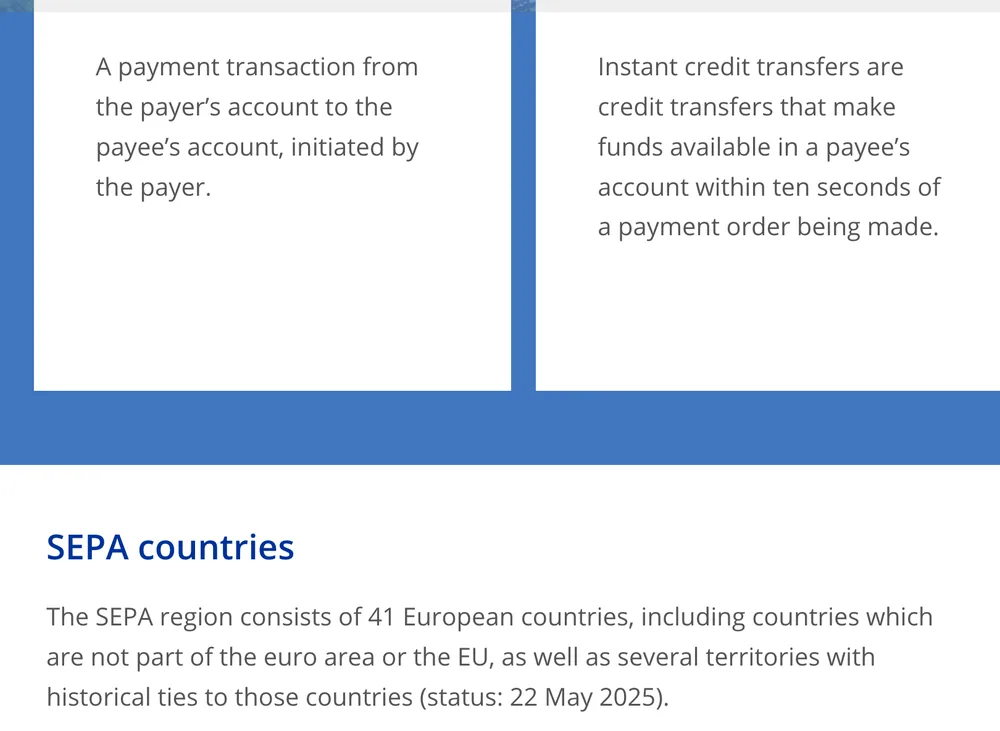
There are two layers to that sentence. First, the SEPA area is bigger than the euro area and bigger than the EU, so “the other side isn’t in the euro area” doesn’t mean “SEPA is out”. Second, all 41 are European countries. Hong Kong, the US and Singapore aren’t in Europe, so a bank account there, even one holding euros, doesn’t send SEPA transfers.
The other half is currency. The ECB page is about cashless payments in euros: sending pounds or dollars between two banks that are both in the SEPA area isn’t SEPA either. For exactly which 41 countries and which territories, check them one by one in the SEPA countries section of that page, rather than guessing from whether a place is in Europe.
03Fees and speed: SEPA instant transfers land within 10 seconds, while a SWIFT wire can shrink on the way
Speed. The ECB’s definition of a SEPA instant transfer states the time outright: funds reach the payee’s account “within ten seconds of a payment order being made”. That page gives no time limit for a standard SEPA transfer. SWIFT has no single figure; Monzo’s comparison article puts it at 1–4 working days.
| Method | Arrives | Fees to watch |
|---|---|---|
| SEPA instant transfer | Within 10 seconds of the payment order | EU rule: providers in the EU can’t charge more than for a standard transfer |
| Standard SEPA transfer | No time limit given on the ECB page | The paying bank sets its own price; check its price list before you send |
| SWIFT wire | 1–4 working days (per Monzo) | On top of the sending bank’s fee, correspondent banks may deduct more |
Fees. The European Commission’s press release of 10 October 2025 says banks and payment service providers “will not be able to charge more for an instant payment than they would for a standard credit transfer”. The same release also sets out a timeline: “From January 2027, euro instant payments will also be available outside the euro area.” Both are new EU rules and apply to payment providers in the EU. The ECB’s SEPA page adds that charging rules coming from EU legislation don’t apply in SEPA countries outside the EU/EEA, and Hong Kong and US accounts are even further outside their reach.
What makes SWIFT fees hard to predict is the middle of the journey. A wire may pass through one or more correspondent banks, each hand-off can take a little, and the recipient ends up with less than was sent. Wise’s EUR account page says as much next to its Swift receiving fee, with the note correspondent bank fees may apply: correspondent banks may charge on top.
Someone outside the euro area sends 1,000 euros by SWIFT to a Wise EUR account; call whatever correspondent banks take along the way x. With the Swift receiving fee of 2.39 euros shown on Wise’s page in September 2026: amount received = 1,000 − x − 2.39 = 997.61 − x euros. Nobody can give you x in advance; it might be 0, or it might not. If the same account instead receives a bank transfer from inside the euro area, the page lists the receiving fee as None: amount received = 1,000 − 0 = 1,000 euros. Whatever the paying bank charges isn’t part of that table.
To stack the sending fee, correspondent bank deductions and the receiving fee into one estimate, use the site’s wire transfer fee calculator. You can set the number of correspondent banks and how much each one takes, then compare a few sets of numbers side by side.
04What to give the sender: two items for SEPA, plus bank details for SWIFT
When someone asks for “your payment details” so they can send you euros, first find out which route they’re using, then decide how much to give. Wise’s help page lists this for EUR accounts:
- Euros sent locally from within Europe: give two things, your Name and IBAN.
- Sent in via Swift from outside Europe: give your Name and IBAN, plus the Bank Name and Address, meaning the bank name and address shown on your account details page.
An IBAN pinpoints the account; a SWIFT code (also called a BIC) pinpoints the bank. They do different jobs, and one can’t stand in for the other. How to break the code down, where to look it up and what happens if it’s wrong are all covered step by step in SWIFT code / BIC: what it is, how to find it and how to use it. If the sending bank’s form has a required SWIFT/BIC field, fill it in as the form asks; don’t decide on your own to leave it blank.
Before you send your IBAN to anyone, you can run it through the IBAN / SWIFT validator for a mod-97 check, which catches format problems such as swapped or missing characters. It can’t check the account holder name registered behind that number; that part relies on the name check in section six, and on you giving the right name.
My own rule is never to type payment details by hand. I copy both the IBAN and the name straight from the account details page, and give the name exactly as it’s written there, without changing a single letter of capitalization or middle name. Once I’ve sent them, I ask the other person to screenshot the screen where they entered them on the transfer form, and I check it against mine field by field.
05One euro account, two ways in: the Wise EUR account as the example
The same EUR account can receive local transfers from the euro area and Swift transfers from anywhere in the world. Wise’s help page “How do I receive money with my EUR account details?” has a table that sets the two side by side:
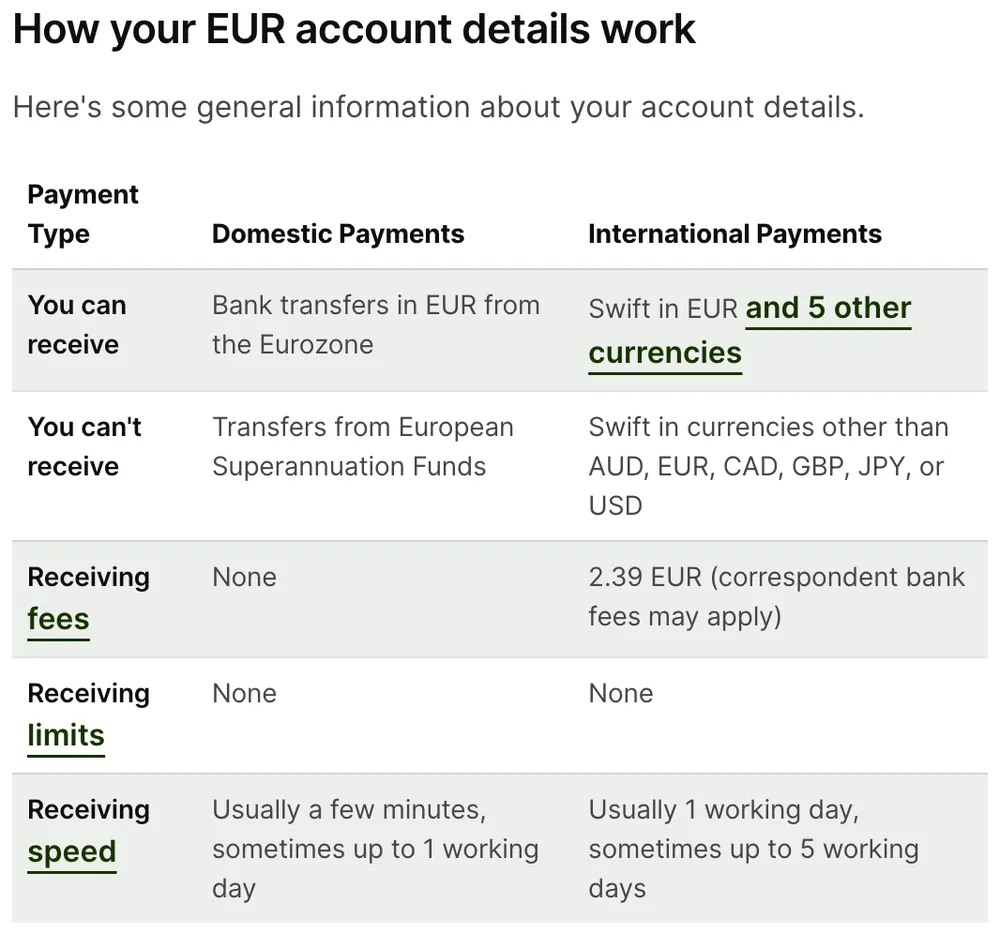
| Row in the table | Domestic Payments | International Payments |
|---|---|---|
| Can receive | Euro bank transfers from the euro area | Euros by Swift, plus 5 other currencies |
| Can’t receive | Transfers from European Superannuation Funds | Swift in currencies other than AUD, EUR, CAD, GBP, JPY and USD |
| Receiving fee | None | 2.39 EUR (correspondent bank fees may apply) |
| Receiving limit | None | None |
| Speed | Usually a few minutes, sometimes up to 1 working day | Usually 1 working day, sometimes up to 5 working days |
Reading this table against the earlier sections, I noted three things:
- The Domestic column says “from the Eurozone”. The scope in the table is the euro area, not SEPA’s 41 countries. The table doesn’t say which column applies to euros sent from a country that’s outside the euro area but on the SEPA list, so first ask which route the sender’s bank actually uses.
- The price gap between the columns is spelled out; the correspondent bank cut isn’t. The Domestic receiving fee is None and Swift is 2.39 EUR, but the words correspondent bank fees may apply after it mean the amount received can’t be pinned down in advance. That’s the x from section three.
- This is how one provider, Wise, put it in September 2026. Another provider’s euro account may differ in fees, speed and the currencies it accepts. Use the table as a model for how to read these, not as an industry standard.
How to open the Wise account itself, and what its local details look like for each currency, is covered in Wise multi-currency account: local details in several countries from one account.
06From 9 October 2025, euro-area transfers check the payee’s name first
The ECB’s Instant Payments Regulation page gives two dates: payment service providers in the euro area offer verification of the payee from 9 October 2025, and those in EU member states that don’t use the euro from 9 July 2027. The check is whether the payee name and the IBAN the payer entered match, and it happens before the money leaves.
The payer doesn’t pay for this step. The regulation page puts it this way: “This service shall be offered free of charge to the payer.”
For you, on the receiving end: the name you give out has to match the name registered on the account. A nickname, just your surname, or a name that mixes versions in two languages can all trigger a mismatch warning on the payer’s side. What happens once that warning appears isn’t covered on the pages I checked, so don’t bet on whether the payment goes through anyway; giving the right name is the part you control.
Don’t stretch the scope either: those two dates apply to payment providers in the euro area and in EU member states outside it. Whether money sent in by SWIFT from outside Europe gets checked the same way isn’t addressed on these pages.
The name check stops “typed it wrong”, not “tricked into paying an account whose name matches”. If you get a message like “we’ve changed our bank account, please pay the new IBAN”, confirm with the person directly using contact details you already had. If you only realize something is wrong after the money has gone, contact the sending bank straight away and report it to your local police.
07Sending euros from a Hong Kong, US or UK account: which route each might take
Work it out in two steps: first check whether the country of the sending account is on SEPA’s list of 41, then look at which euro transfer options your bank actually offers. Every bank’s options, fees and names differ. The table below is the skeleton of the decision; for any particular bank, check its own pages.
| Sending account | On the SEPA list? | Likely route | Check before you send |
|---|---|---|---|
| Hong Kong bank account | No; Hong Kong isn’t in Europe | International wire, SWIFT or similar | Whether you send from a HKD or EUR balance, the exchange rate, the sending fee, correspondent bank deductions |
| US bank account | No; the US isn’t in Europe | International wire, SWIFT or similar | Whether the bank can send in euros, the exchange rate, correspondent bank deductions |
| UK bank account | Check the ECB’s list | Depends on the bank: only if it offers a euro transfer option and both ends are on the list can it be SEPA; otherwise it’s an international wire | Whether the account holds euros, and whether online banking has a euro transfer option |
The Hong Kong and US rows work the same way: the money starts outside Europe, so even when it’s going to a euro-area IBAN, it’s a cross-border wire. Prepare the payment details from the SWIFT item in section four, and use the sum in section three to leave room for correspondent bank deductions. If the account holds Hong Kong dollars or US dollars, there’s an extra step converting to euros, with the spread on top; that’s broken down in exchange rates and the spread: where your money quietly leaks.
I’ve deliberately left the UK row open. The UK is in Europe, but between “in Europe” and “this account can send SEPA euro transfers” there are still two questions: is the country on the list, and does your bank offer the option? Only once both are confirmed should you count it as SEPA.
There’s one more way to set it up. If the recipient has given you an IBAN inside the SEPA area, and you happen to have another account that’s also inside the area and already holds euros, you can do the last leg as a transfer within the area and skip a SWIFT wire. If that account first needs money moved in from a Hong Kong or US account, work out how that step goes and what it costs as well, or you’ve just shifted the correspondent bank deductions to an earlier leg. Which route is cheaper also changes with the amount, so run your own numbers through how to spend less on cross-border transfers: wires and the alternatives.
08Questions people often ask about sending and receiving euros
Can SEPA be used to send dollars or pounds? No. SEPA only handles euro payments; dollars and pounds go through international wires or other channels. Some euro accounts can receive several currencies via Swift. Wise’s EUR account details, for example, listed euros plus Australian dollars, Canadian dollars, pounds, yen and US dollars on the page in September 2026, but that’s money arriving by Swift, and it has nothing to do with SEPA.
For a transfer within the euro area, do I need to give a SWIFT code as well as the IBAN? It depends on the form the payer is using. For EUR accounts, the details Wise lists for receiving within Europe are just name and IBAN; for money coming in via Swift from outside Europe, the list adds the bank name and address. If the transfer page has a required SWIFT/BIC field, fill it in, and find the code in the account details your receiving provider gives you.
Do SEPA instant transfers cost more than standard ones? Within the EU, under the rules, they shouldn’t. The European Commission’s press release of 10 October 2025 says payment providers can’t charge more for an instant payment than for a standard transfer; that rule doesn’t reach SEPA countries outside the EU/EEA. As for what a standard transfer costs in the first place, check the paying bank’s price list before you send.
Does the payee name check cost anything, and when does it start? It’s free for the payer; the ECB regulation page’s wording is "free of charge to the payer". Payment providers in the euro area offer it from 9 October 2025, and those in EU member states that don’t use the euro from 9 July 2027.
The sender says they sent 1,000 euros, but I got less. Where did the difference go? If it went by SWIFT, deductions can happen in three places: the sending bank’s fee, deductions by correspondent banks along the way, and the receiving provider’s incoming fee. Taking the Wise EUR account, the Swift receiving fee on its page in September 2026 was 2.39 euros, with a note that correspondent banks may charge on top. Ask the sender for the transfer receipt and first check how much the sending bank took. Correspondent bank deductions don’t always show up on the receipt, so the sending bank may need to trace them.
- European Central Bank: Single Euro Payments Area (SEPA) — source for the 41-country description (status: 22 May 2025) and the definition of instant transfers arriving within 10 seconds
- European Central Bank: Instant Payments Regulation — source for the two start dates of the payee check and for it being free for the payer
- European Commission press release (2025-10-10) — source for instant payments costing no more than standard transfers, and for euro instant payments outside the euro area from January 2027
- Wise Help Centre: How do I receive money with my EUR account details? — source for the fees, speeds and details list for the two ways into a EUR account (as shown on the page in September 2026)
- Monzo: Swift vs SEPA — source for SWIFT taking 1–4 working days