Which route your Hong Kong card money can take back to the Mainland depends on your ID card
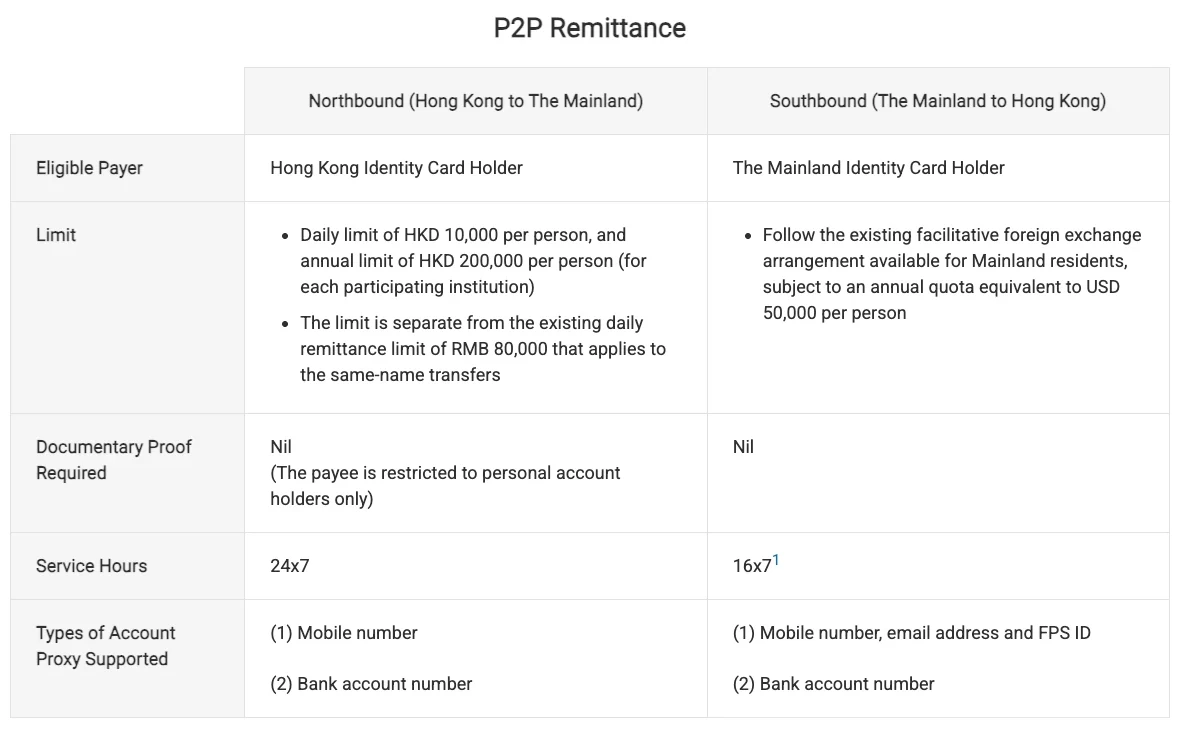
If you hold a Hong Kong Identity Card, there are two ready-made ways to move money from a Hong Kong card back to the Mainland: a real-time transfer through Payment Connect northbound, capped at HKD 10,000 per person per day, or an RMB remittance through a Hong Kong bank into your own same-name personal account in the Mainland, capped at RMB 80,000 per person per day. If you only hold a Mainland ID card, neither fits: northbound payers must be Hong Kong Identity Card holders, and the RMB 80,000 route is for Hong Kong residents.
If all you have is a Mainland ID card and a Hong Kong card, ask the Hong Kong bank that issued the card whether it can send an ordinary cross-border remittance to your own account in the Mainland. Once foreign currency reaches the Mainland side, converting it to RMB falls under the foreign exchange regulator's facilitative quota for individuals.
Some e-wallets operating in Hong Kong also offer cross-boundary personal remittances to Hong Kong residents, with limits tiered by account verification level. E-wallets aren't covered here; this piece sticks to banks and Payment Connect.
01Who each official channel from a Hong Kong card to the Mainland is open to
| Channel | Who can use it | Limit | Where the money goes |
|---|---|---|---|
| Payment Connect northbound | Hong Kong Identity Card holders | HKD 10,000 per person per day and HKD 200,000 per person per year (for each participating institution) | A personal account in the Mainland; payees are restricted to individuals |
| RMB remittance through a Hong Kong bank | Hong Kong residents | RMB 80,000 per person per day | Your own same-name personal account in the Mainland |
| HKD or other foreign-currency remittance through a Hong Kong bank | Hong Kong residents | Neither the same-name rule nor a daily limit applies; converting on arrival uses the recipient's facilitative quota of USD 50,000 equivalent per person per year | The Mainland recipient's account |
| Salary remittance | Mainland residents working in Hong Kong | Salary remittances verified by the bank can stay outside the annual facilitative quota | Some banks' services can send it to an account in your own name or a family member's in the Mainland |
If you hold both a Hong Kong Identity Card and a Mainland ID card, ask the Hong Kong bank that issued your card whether you can use northbound. Payment Connect services are provided by the participating institutions, and the functions and coverage may differ from one institution to another.
02Two ways to send Hong Kong card money to the Mainland with an HKID
Payment Connect is the link between the Mainland's Internet Banking Payment System (IBPS) and Hong Kong's Faster Payment System (FPS). Northbound transfers start in your Hong Kong card's mobile banking app and are real-time, small-value remittances. The supported account proxies are a mobile number and a bank account number, and no documentary proof is required. Its limit is separate from the RMB 80,000 daily limit on same-name transfers.
The RMB same-name transfer is a conventional bank remittance. The money has to go on spending such as travel, business trips, study, daily life or family support, and it can't be used to invest in Mainland financial products; property purchases in the Mainland have their own remittance arrangement. RMB remittances for these purposes can also be sent without using up the daily limit, provided the recipient in the Mainland gives the receiving bank whatever it asks for to show that the remittance is genuine and compliant.
Some Mainland receiving banks may, for internal compliance reasons among others, run extra checks when large amounts land in the same account on several consecutive days. If you plan to send fairly large sums back over several days in a short period, ask the Mainland receiving bank first which documents to prepare.
Sending HKD or another foreign currency instead doesn't change the rules on how the money is used. Once it reaches the Mainland, the recipient can convert it to RMB at the receiving bank within the facilitative quota by showing identity documents, with no proof of genuineness needed. Above the quota, or if the recipient chooses not to use it, the Mainland bank needs supporting documents.
03Mainland ID card only: which route the money in your Hong Kong card can take
If you only hold a Mainland ID card, neither northbound nor the RMB same-name transfer above fits. What's left to ask about is an ordinary cross-border remittance from the Hong Kong bank that issued your card to your own account in the Mainland. Whether it can be done, in which currency and at what fee depends on that bank's answer and its fee schedule; if you want to send RMB, ask both the Hong Kong remitting bank and the Mainland receiving bank.
A SWIFT wire may pass through intermediary banks on the way. Once you know the amount, enter the cable charge, the number of intermediary banks and who bears the fees in the wire transfer fee calculator to estimate what actually arrives.
Once foreign currency is in a Mainland account, converting it to RMB follows the State Administration of Foreign Exchange's Guidelines on Current Account Foreign Exchange Business (2020 edition). Article 54 requires individual current-account foreign exchange business to have a genuine, lawful transaction background, and manages individual currency conversion through an annual facilitative quota of USD 50,000 equivalent per person. Under Article 56, current-account conversions that an individual in the Mainland makes at a bank with their own valid ID and documents showing the source of the funds, with the transaction amount on them, don't use the annual facilitative quota.
If you work in Hong Kong and are sending your salary back, there is more room. Salary remittances verified by the bank can stay outside the annual facilitative quota, and for later remittances of the same kind at the same bank, once the bank has confirmed that the salary is genuine and reasonable, it can rely on the first one and skip checking the same documents again. Some banks offer salary remittance services: once the bank has reviewed proof of income such as your employment contract, tax payment certificates and bank statements, the salary can go to a Mainland bank account in your own name or a family member's, and later remittances don't need the documents again.
04The other direction: Payment Connect southbound into your own Hong Kong card
Turn the direction around and a Mainland ID card becomes usable. Southbound payers are Mainland Identity Card holders, who start the transfer at a Mainland participating institution and can send it to their own personal account in Hong Kong. For the payee you enter the Hong Kong account's mobile number, email address, FPS ID or bank account number, and again no documentary proof is required.
The southbound limit is simply the existing annual facilitative quota of USD 50,000 per person for buying foreign currency. Money bought within the quota can generally only go on consumption spending. Above the quota, or outside it, you can use supporting documents to show the money is going on eligible spending, such as travel, tuition and living costs while studying abroad, or medical bills outside the Mainland, and the bank processes it after review.
05Using Payment Connect with a Hong Kong card: banks, payees and service hours
Can I use Payment Connect with my Hong Kong bank? Participating institutions on the Hong Kong side include Bank of China (Hong Kong), HSBC, Hang Seng, Standard Chartered, Bank of East Asia, ZA Bank, Ant Bank and Mox. Every bank on the list supports it through its mobile banking app, and some through internet banking as well. The full list is in the participating institutions table on the HKMA's Payment Connect page; find your bank there, and if anything is unclear, call its service enquiry hotline.
Can I send money to my parents' bank card in the Mainland through Payment Connect northbound? Yes; northbound payees are restricted to individuals. A small remittance such as a few thousand HKD a month to cover a father's living costs in the Mainland can go through Payment Connect to his Mainland bank account. Sending by Mainland mobile number to a Mainland resident's account that has cross-boundary receipt by mobile number turned on is a feature being introduced gradually; check your Hong Kong bank's mobile banking app to see whether it supports it.
How late at night can I use Payment Connect? Northbound runs 24x7, so transfers from a Hong Kong card to the Mainland work at any hour. Southbound runs 16x7: the current service hours are 7:00 a.m. to 11:00 p.m. daily, and they may vary slightly between Mainland participating institutions. For transfers from the Mainland into your Hong Kong card, avoid 11 p.m. to 7 a.m.
- Hong Kong Monetary Authority: Payment Connect — payer eligibility, limits, documentary proof, service hours and account proxies for northbound and southbound, plus the Hong Kong and Mainland participating institutions
- Hong Kong Monetary Authority: Personal cross-boundary remittance between Hong Kong and the Chinese Mainland — the RMB 80,000 daily same-name remittance and foreign-currency remittances by Hong Kong residents, salary remittances by Mainland residents working in Hong Kong, and the currency conversion quota for Mainland residents
- State Administration of Foreign Exchange: Guidelines on Current Account Foreign Exchange Business (2020 edition) — Article 54 on the annual facilitative quota for individual currency conversion and purchase, Article 56 on current-account conversions that don't use the quota